80% of infrastructure projects die before the money arrives. Here is how we are closing that gap in Ukraine
- 80% of infrastructure projects die at the feasibility and business planning stage, and only 10% reach implementation - the cause is preparation, not war or a lack of capital.
- MISFU pays for stages 1 to 4 of a qualified municipal project, up to a finished feasibility study, without a tender and without spending from the municipal budget.
- Koblevo joined MEFP on 22 September, and Artsyz has started its master plan process building on the Artsyz 2040 Vision.
Economy of Trust Ukraine Project Portfolio, October 2026
In September Brookings published McKinsey’s analysis of what it calls Africa’s infrastructure paradox. In Sub-Saharan Africa there is demand for infrastructure, a list of prepared ideas, and investors ready to put capital behind them. Even so, 80% of infrastructure projects die at the feasibility and business planning stage, and only 10% reach implementation. More than half of the pipeline has sat at feasibility for years.
McKinsey names six failures behind this: a weak or randomly selected pipeline, poor feasibility and business planning, permit delays, badly allocated risk, missing guarantees and offtake contracts, and weak delivery management. None of the six is about war, sanctions or politics. All six are about preparation.
Ukraine tends to explain stalled projects by the war and by budget shortages. The countries in the Brookings piece are not at war, and the money for their infrastructure is already there, yet the result is the same 10%.
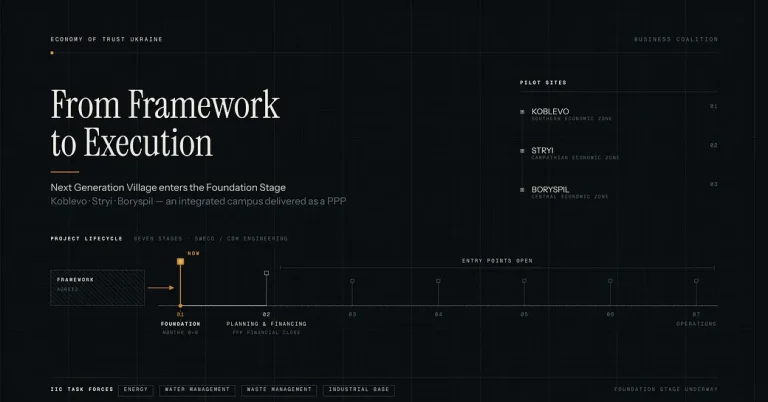
Every project we work on passes through seven stages: concept, development, pre-feasibility, feasibility, construction, launch and operation. Stages 1 to 4 are the preparation, from the first idea to a finished feasibility study. That is where the filter sits, and it works the same way in Kenya, Nigeria and a Ukrainian municipality.
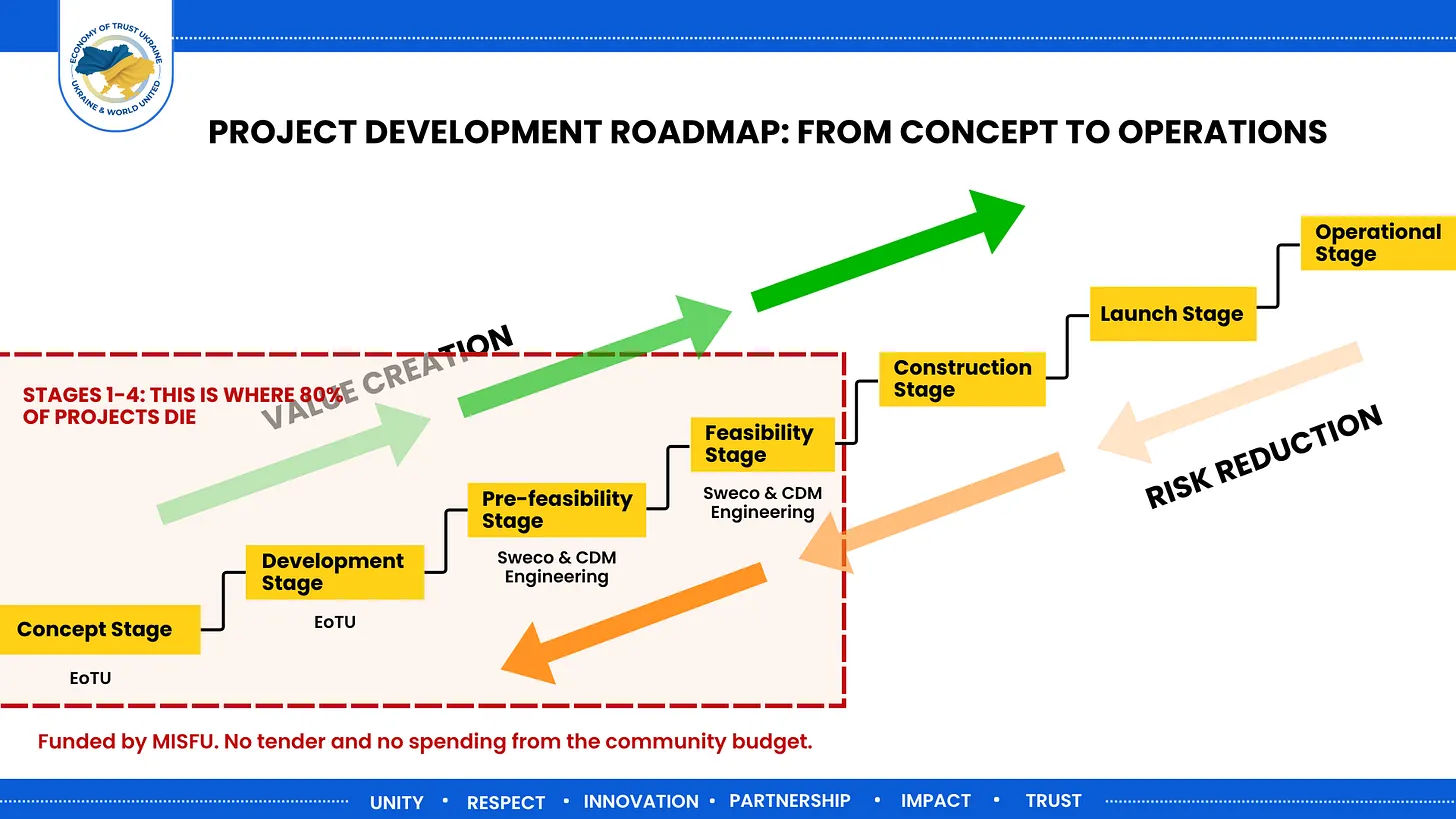
Who pays for stages 1 to 4
That leaves one practical question for every project in our portfolio: who pays for preparation?
If the answer is the municipal budget, the project almost certainly never starts. Preparation money is always short, and it is hard to justify to a council before there is a result. If the answer is the investor, the investor comes in after stage 4, not before. The 80% die in that gap.
The Municipal Infrastructure Seed Fund of Ukraine (MISFU) is built for it. The fund pays for stages 1 to 4 of a qualified municipal project, up to and including feasibility, without a tender and without spending from the municipal budget. An independent financial institution will manage it, and the Economy of Trust Ukraine and its partners supply the deal flow. Sweco prices this preparation at €800,000 to €1,250,000 for a municipality of 100,000 residents. After stage 4 the project is a finished investment product that development banks, lenders and grant programmes can enter. How the fund works: MISFU overview.
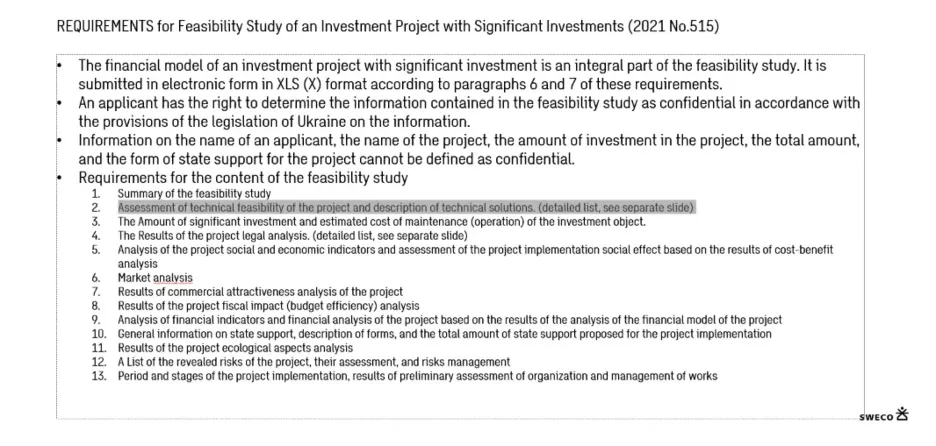
What the feasibility study has to contain
An investor judges a project by its feasibility study. For projects with significant investment, Cabinet of Ministers Resolution No. 515 of 19 May 2021 sets 13 sections, and each answers one question an investor or the state will ask: what the project is, whether it can be built, what it costs to build and run, its legal basis, its social and economic effect, its market, its commercial appeal, its budget impact, its financial model, the state support it needs, its environmental impact, its risks and its schedule. The financial model is submitted as a separate Excel file.
This is where most municipal projects stop, because 13 sections need engineers, lawyers, financiers and environmental specialists working at the same time. We have split the sections between Economy of Trust Ukraine and partner companies so that each is prepared by the right specialists. That work is under way with Stryi and Vyzyrka and is now starting with selected municipalities in other economic zones.
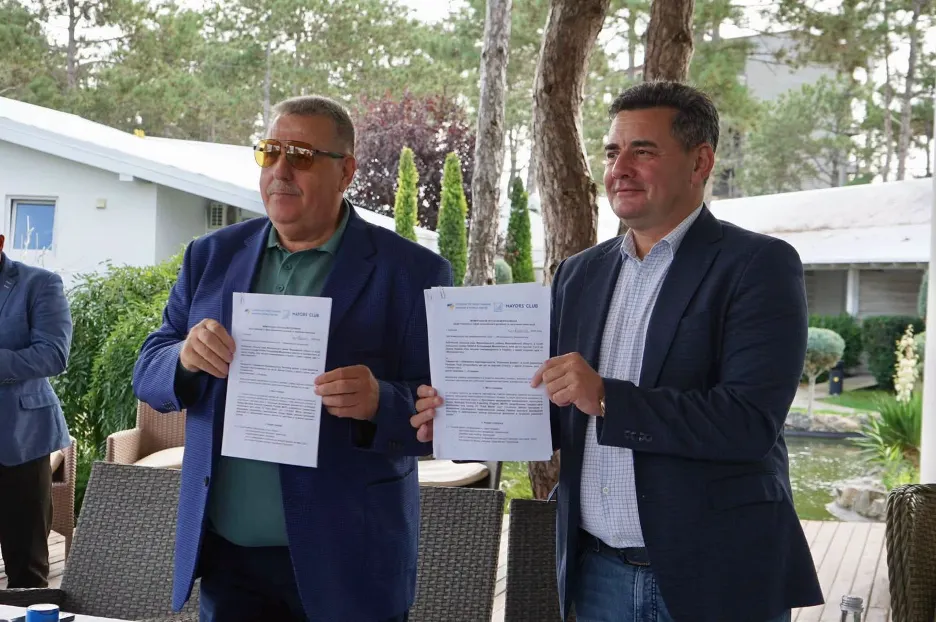
This month’s focus: Koblevo
On 22 September Koblevo municipality joined MEFP, our programme that prepares a municipality for investment. Village head Volodymyr Panych and Economy of Trust Ukraine director Henry Shterenberg signed the memorandum, with Mykola Marinov, deputy head of the Mykolaiv Regional Military Administration, and Anton Tabunshchyk, head of the Mykolaiv Regional Council, present. A development master plan is Koblevo’s next step.
MEFP assesses a municipality’s economic potential and sets its individual vision and priority sectors, so that its projects enter stage 1 with a clear basis. Programme FAQ: MEFP FAQ.
Artsyz municipality in Odesa region has started its master plan process this month, building on the Artsyz 2040 Vision.
New projects enter at stage 1 through a short needs assessment. With the Danish construction company REXCON ApS we built a questionnaire that records a municipality’s building needs in nine blocks, from priority needs and site readiness to local contractors, financing and obstacles. A second one, on energy and resource needs, collects the data that waste and waste-to-energy partners need to assess a territory. Both take 20 to 30 minutes and put a municipality’s needs on paper in a form that contractors, development banks and the fund can check.
Discuss current opportunities
If you are interested in entering the Ukrainian market, or in the projects described above, contact the Economy of Trust Ukraine team to discuss current opportunities.
Book a call: schedule a meeting with Yaroslav Zharikov
Brookings article: Figures of the week: Africa’s infrastructure paradox
Контакти
Yaroslav Zharikov, Project Development Manager at the Economy of Trust Ukraine
yaroslav.z@economyoftrustua.com, +380 97 388 1340 (WhatsApp)
Originally published in Opportunity Ukraine on Substack.