Ukraine: Municipality will drive post-war economy
Post-war Ukraine's economy is being rebuilt from an unusual place: the municipality, not the ministry.
- Since the 2014-2015 decentralization reforms, 675+ municipalities drive reconstruction planning themselves, and the time to secure investable assets is before the war ends, not after.
- Ukraine can build physical, digital and financial infrastructure as one system, with independent governance verifying evidence at each of seven project gates.
- Municipalities have submitted over 3,200 projects, 49 PPP projects passed initial screening with the PPP Agency, and 20+ businesses have joined a coalition across 12 sectors.
For a century, capital and decision-making in Ukraine flowed one way: top-down. Since the 2014/15 decentralization reforms, that’s flipped. 675+ municipalities are now actively driving reconstruction planning themselves.
That creates a rare opportunity, but also a narrow window. The core risk-management insight is simple: the time to secure investable assets is before the war ends, not after.
Once a ceasefire or settlement is reached, capital will flood in at once, and the projects that already hold investable, de-risked status will be the ones that capture it. Waiting until conditions are «safe» means arriving after the best positions are already taken.
More specifically, now is the time to build physical, digital, and financial infrastructure as ONE integrated system, not three separate problems solved decades apart, the way most countries have had to do it.
Here’s why that matters:
-
Physical infrastructure is destroyed or outdated, a genuine clean slate
-
Digital infrastructure barely exists yet, so it can be built for transparency and verifiability from day one, not retrofitted onto legacy systems
-
Financial infrastructure has been missing because unverifiable projects are unbankable; solve the data problem, and you solve the capital problem
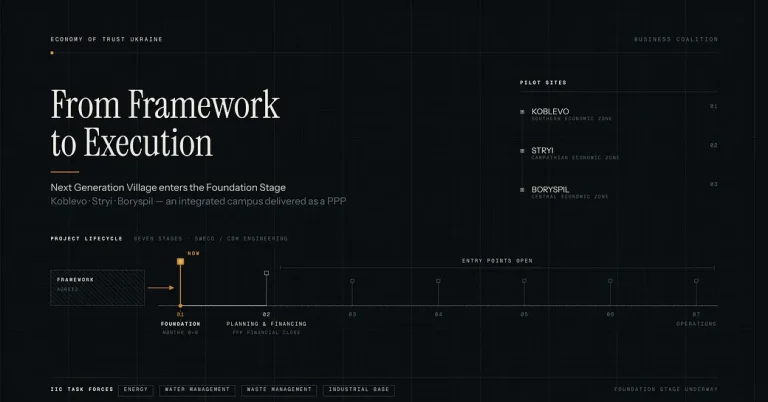
The result is a 7-gate project pipeline: Concept → Development → Pre-feasibility → Feasibility → Construction → Launch → Operational, where independent governance verifies evidence at every stage, separated from anyone with a commercial stake in the outcome. That’s what lets institutional capital trust a project it didn’t originate.
The early economics are striking: the steepest value creation happens before construction capital ever enters, exactly where the least money has been spent. Seed capital targeting that stage is modeling blended base-case returns around 4x with an average of a 12-month holding period, with strong cases well beyond that.
This isn’t theoretical. 675+ municipalities engaged. 30 regional economic zones. Over 3,200+ projects already submitted by municipalities themselves; 49 PPP projects went through initial screening with the PPP Agency of Ukraine; 20+ businesses inside a coalition spanning 12 infrastructure sectors, each one a small, diversified bet on securing investable status ahead of the crowd.
Ukraine doesn’t have to retrofit digital transparency and capital markets access onto old infrastructure the way most economies did. It gets to build all three together, natively, while pulling in the best engineering, governance, and capital market practices the world has to offer, matched with something no outsider can replicate: 675 mayors who know their own municipalities better than any central planner ever could.
The countries and investors who move now, cheaply, broadly, and with disciplined feasibility work, will hold the assets everyone else is trying to buy the moment the risk premium drops.
Watching a country build the connective tissue for a genuinely new kind of economy, in real time, mid-war, is rare. Ukraine is doing it.
Originally published in Opportunity Ukraine on Substack.